Newborn Growth Spurts and Fussy Weeks, Week by Week
Most newborns have a few predictable rough patches in the first 12 weeks, and many parents notice them around week 2 to 3, week 5 to 6 and week 10 to 12. Crying often peaks somewhere around 6 to 8 weeks and then eases. Knowing a hard stretch is common and usually temporary does not make it easy, but it can make it feel less personal. The weeks below are commonly reported ranges, not a script. Your baby may skip, shift or blend any of them, and premature babies often follow their adjusted age.
Quick map of the first 12 weeks
| Week | Often seen | What may help |
|---|---|---|
| 1 | Lots of sleep in short pieces, waking to feed. Day and night look the same. | Feed on cue, skin to skin, rest when baby rests. |
| 2 | Frequent feeding is common. A first fussy patch can show up. | Keep a simple feed log. Ask your pediatrician about weight checks. |
| 3 | Some babies start a fussy period in the evening. Growth spurts are commonly reported around now. | Shushing, holding, a change of scenery. |
| 4 | More alert time. Cluster feeding in the evening is common. | Fill the tank earlier in the day. Let evenings be low-key. |
| 5 | Fussing may build in the late afternoon and evening. A growth spurt is commonly reported around 5 to 6 weeks. | Shorter wake windows, dim lights, a steady sound. |
| 6 | Crying often peaks for many babies and can last hours with no clear reason. | Hold, walk, rock, change rooms. Take turns with a helper. |
| 7 | Many babies still fuss in the evening. Some give first real smiles. | Keep routines small and repeatable. |
| 8 | Some babies start to ease up. Sleep may still be unpredictable. | Keep days bright and nights dim. |
| 9 | More social and curious. Some babies still have a fussy evening. | A short wind-down in the same order each night. |
| 10 | Some babies work toward a longer night stretch, but many do not yet. | Offer full feeds in the day. Do not force a schedule. |
| 11 | Growth spurts and developmental leaps are commonly reported around 10 to 12 weeks. | Expect a bumpy few days, then a reset. |
| 12 | Many babies are more predictable. Others are still finding their rhythm. | Review what helped. Keep that. |
What a growth spurt looks like
A growth spurt is a short stretch when a baby wants to feed much more. Many babies have them around 2 to 3 weeks, 6 weeks and 3 months. It typically lasts a few days.
- Baby wants to feed more often, sometimes every 30 to 60 minutes for a few hours.
- Baby may be fussier, or sleepier in between.
- Naps and nights may look different for a day or two.
What to do: feed on demand and rest when you can. Cluster feeding is common, usually in the evening, and does not automatically mean low milk supply. If you are worried about feeding or weight gain, ask your pediatrician or a lactation professional.
The evening fuss, or "witching hour"
Many babies have a fussy period in the late afternoon or evening, often starting around 2 to 3 weeks, peaking around 6 weeks, and easing by about 3 to 4 months. It can include cluster feeding and crying that is hard to soothe.
Things that help some families:
- Offer frequent feeds if baby wants them.
- Try babywearing, a walk outside or a warm, dim room.
- Use white noise at a low volume and gentle motion.
- Hand baby to a partner and take 10 minutes alone.
- Plan ahead: eat dinner early and decide in advance who takes the first hand-off.
Healthy babies can cry a lot in the early weeks, often more in the evening. The AAP and NHS both describe this pattern. It is a phase, and it is not a sign you are doing something wrong.
The weeks 6 to 8 bump
Many parents notice a rough patch in this window. Baby is more alert, fussier in the evenings and sleep may feel messier. It is easy to read this as a regression. It is often a developmental stretch, and first social smiles also arrive around now. Keep the safe sleep basics unchanged, offer extra cuddles and feeds if baby asks, keep daylight and nighttime contrast, and take turns. See newborn wake windows by week if you want to check whether baby is awake longer than they can handle.
A quick soothing checklist
When baby is fussy and you have run out of ideas, go through this list one item at a time:
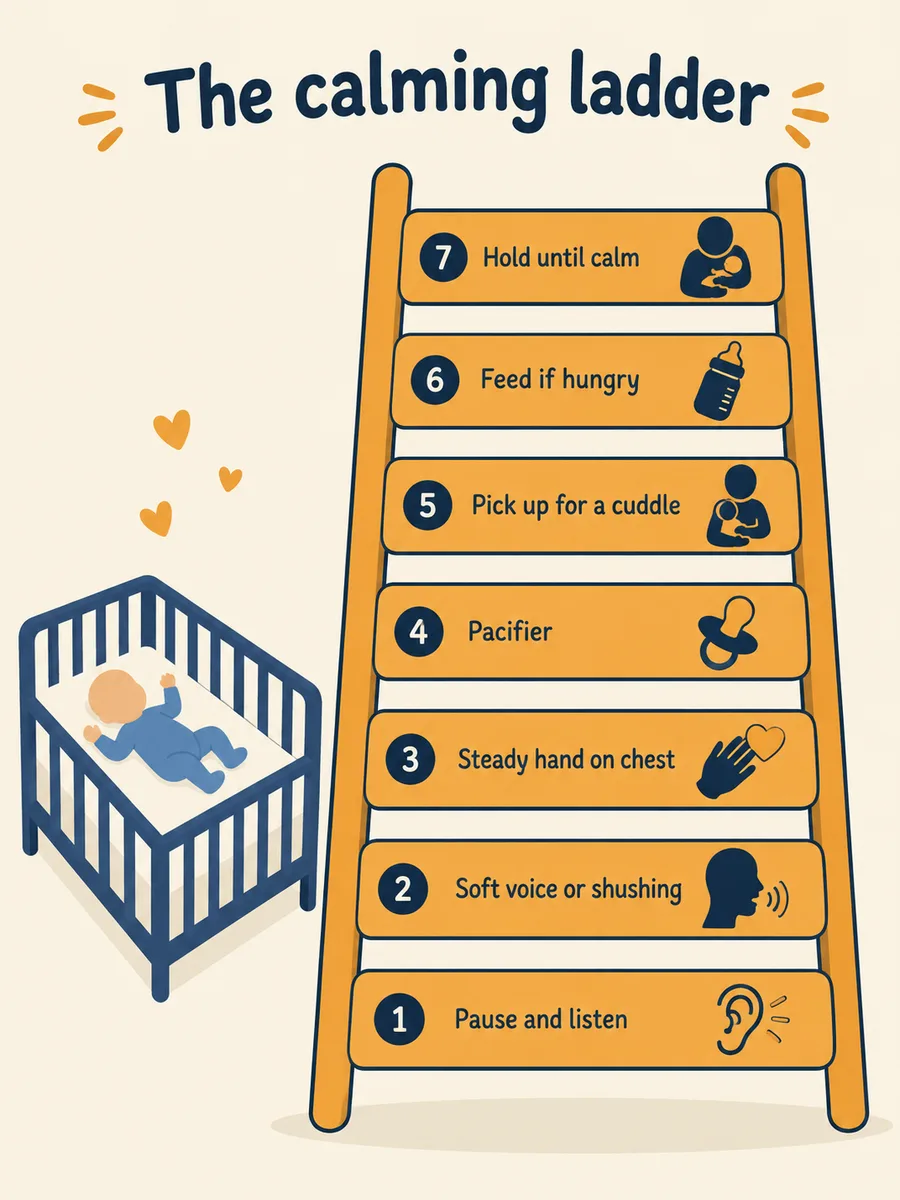
- Check feed, diaper, temperature and anything tight or scratchy.
- Lower the lights and the noise.
- Hold close or skin to skin.
- Slow rocking, swaying or walking.
- Steady shushing or low white noise.
- Offer sucking: a feed, or a pacifier if you use one.
- Change the scene: another room, a stroller walk, fresh air.
- Hand baby to someone else and take 10 minutes.
If you hit your limit
Crying that does not stop can push anyone to the edge. If you are losing patience, place baby on their back in a safe, empty crib, close the door and take a few minutes to breathe. Never shake a baby. Then call a person you trust. Splitting nights helps too: see newborn nights with a partner.
When to call your pediatrician
Do not assume it is "just a phase" when other signs appear. Call right away if:
- Baby is under 3 months and has a rectal temperature of 100.4°F (38°C) or higher.
- Baby is hard to wake, very floppy or limp.
- Baby is feeding poorly or has fewer wet diapers than expected.
- Baby has persistent vomiting, especially green or bloody.
- Baby has trouble breathing.
- Crying is nonstop, high-pitched, weak or sounds different, or you suspect pain or illness.
Call 911 for an emergency. Calling is never an overreaction.
Tracking helps you see patterns
Patterns are easier to see on paper than at 3 a.m. Each day, tick one or two boxes (fussy evening, cluster feeding, short naps, harder night), look back on Sunday and write what helped. Bring the page to your pediatrician visit if you have questions. A layout for that is described in newborn feeding and sleep log.
When the 3 to 4 month stretch arrives, see the 4 month sleep regression.
A calendar for the fridge
The Newborn Sleep Playbook includes a Fussy Weeks & Growth Spurts Calendar with the week-by-week table above and a 12-week tracker, plus a troubleshooting chapter on the witching hour and a Partner Night-Shift Planner for splitting hard evenings. It is educational and does not replace your pediatrician's advice.