6 Month Old Nap Schedule: Sample Days from 5 to 12 Months

A 6 month old typically takes about 3 naps a day with awake windows of roughly 1.5 to 2.5 hours, and by 9 to 12 months most babies are on 2 naps. The exact numbers vary by baby, and the schedules below are examples, not rules. Use this page to see what is commonly expected at each age and how to handle the moves from three naps to two (and later two to one).
Typical sleep from 5 to 12 months
| Age | Naps per day | Nap time total | Night sleep |
|---|---|---|---|
| 5–6 months | 3 (sometimes 4 short) | 3–4 hrs | 10–12 hrs with wakings |
| 7–8 months | 2–3 | 2.5–3.5 hrs | 10–12 hrs |
| 9–10 months | 2 | 2–3 hrs | 10–12 hrs |
| 11–12 months | 2 (some move to 1 later) | 2–3 hrs | 10–12 hrs |
Night wakings, short naps now and then, and a sleep dip around big developmental changes are all common at this age. Many babies still wake to feed at night. Ask your pediatrician what is right for yours.
Wake windows by stage
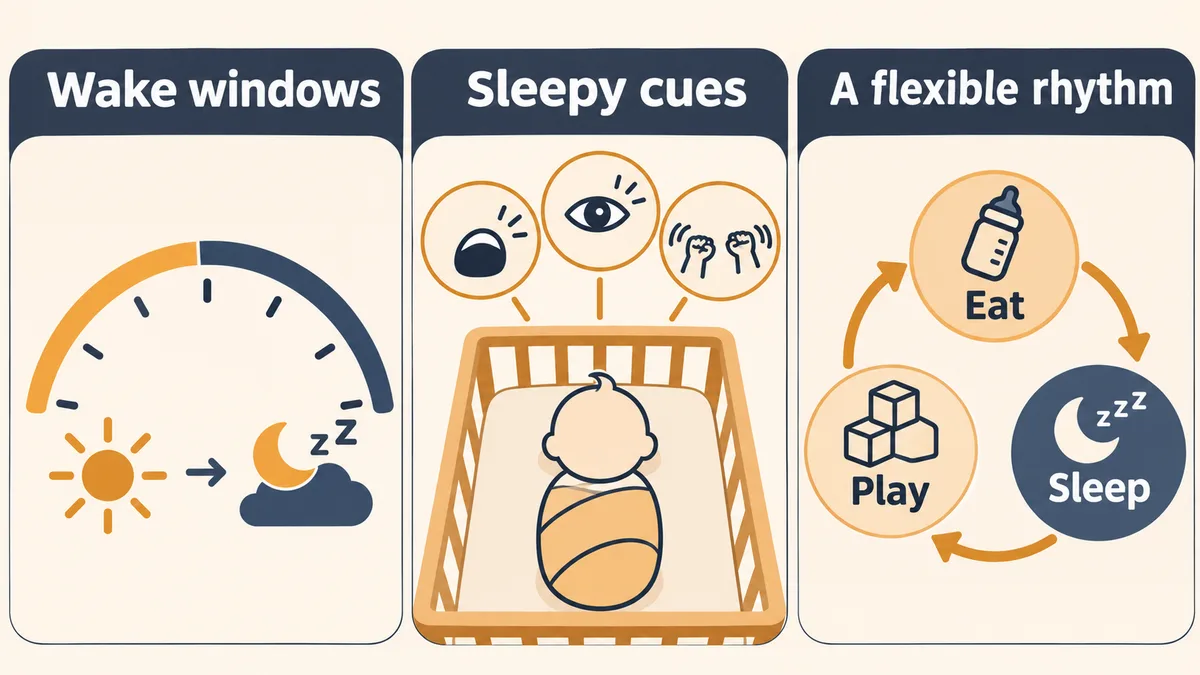
Commonly cited wake windows (approximate). Watch your baby, not just the clock.
| Age | Typical wake window | First window of the day | Last window before bed |
|---|---|---|---|
| 5–6 months | 1.5–2.5 hrs | 1.5–2 hrs | 2–2.5 hrs |
| 7–8 months | 2–3 hrs | 2–2.5 hrs | 2.5–3 hrs |
| 9–10 months | 2.5–3.5 hrs | 2.5–3 hrs | 3–3.5 hrs |
| 11–12 months | 3–4 hrs | 3 hrs | 3.5–4 hrs |
Windows usually start shorter in the morning and get longer through the day.
Sample day at 5 to 6 months (three naps)
| Time | What happens |
|---|---|
| 6:30–7:00 am | Wake and feed |
| 8:15 am | Nap 1 (about 45 min–1.5 hrs) |
| 10:45 am | Feed and play |
| 11:00 am | Nap 2 (about 1–1.5 hrs) |
| 1:30 pm | Feed and play |
| 2:45 pm | Nap 3 (short, 30–45 min) |
| 4:30 pm | Feed, play |
| 6:30 pm | Bedtime routine begins |
| 7:00–7:30 pm | Bedtime |
Sample day at 9 to 10 months (two naps)
| Time | What happens |
|---|---|
| 6:30–7:00 am | Wake and feed |
| 9:30 am | Nap 1 (1–1.5 hrs) |
| 1:30 pm | Nap 2 (1–1.5 hrs) |
| 5:00 pm | Dinner and play |
| 6:45 pm | Bedtime routine begins |
| 7:15 pm | Bedtime |
Bedtimes between about 6:30 and 8:30 pm are common. Many families choose the time that fits their lives, and that is fine. Match the order of events and the spacing, not the exact minutes.
Moving from 3 naps to 2
Many babies make this move sometime between about 6 and 9 months. Signs commonly cited:
- The third nap is regularly refused or very short.
- Bedtime is turning into a fight because the third nap pushes it late.
- Your baby can stay happily awake for around 2.5 to 3 hours at a time.
- Night sleep is getting split or starting later.
How to make the change: offer the third nap only if your baby seems to need it, and keep it short (30 minutes or less). Stretch the first two wake windows by 10 to 15 minutes every few days, and move bedtime earlier for a while (about 30 to 60 minutes) while your baby adjusts. Dropping a nap can feel like a mini sleep regression, and it usually takes a few weeks to settle.
Why naps end early
- Sleep cycles are short (about 45 to 60 minutes), so a nap can end at the first cycle.
- Babies learn to link cycles together with practice and time.
- New skills such as rolling, crawling and pulling up can be so exciting they get practiced at 2 a.m.
Too short or too long a window?
- Fights going down, wakes after 20 to 30 minutes: the window may have been too long for that nap.
- Playing in the crib for a long time before sleeping: the window may have been too short.
- Wired and hard to settle in the evening: the day may have had too much awake time.
Adjust by 10 to 15 minutes at a time.
Safe sleep through the first year
Safe sleep rules do not stop when your baby learns to roll. The AAP recommends the same basics through the whole first year: baby on their back for every sleep, on a firm, flat surface with a fitted sheet and nothing else. Keep the crib empty (no pillows, blankets, bumpers, stuffed toys or positioners) and use a wearable blanket instead of loose blankets. Once your baby can sit or pull up, lower the mattress to its lowest setting. If your baby uses a white noise machine, see white noise for newborns.
Where this fits
If your baby is younger, see the 3 and 4 month old sleep schedule and the 4 month sleep regression. For a bedtime routine that adapts to any age, see newborn bedtime routine.
About the product
The Newborn Sleep Playbook is written for weeks 0 to 12, so its schedules stop where this page starts. The bedtime routine, cues and safe sleep chapters carry over. A separate, paid 5–12 Month Nap & Routine Playbook covers this age in depth and is not part of this one. It is educational and does not replace your pediatrician's advice.