How to Get a Newborn to Sleep: A Plan by Stage
You get a newborn to sleep with a short plan, not a single trick: make the sleep space safe, catch the early sleepy cues, keep wake windows short, soothe with one step at a time and lay baby down on their back. Then repeat it gently, day after day. That is also why the quick tricks you find online work one night and fail the next. A newborn's sleep is short, scattered and changes by the week, so what helps most is a plan that changes with it.
This page lays that plan out in five stages. It does not promise that your baby will sleep all night, because no honest guide can. It aims at something more reachable: calmer settling, a little more predictability and more rest for you.
Why one trick rarely works
In the first weeks your baby sleeps in short stretches around the clock and wakes to feed often. Totals vary a lot from baby to baby. The reasons a baby fights sleep also change within a single day: hungry, gassy, overstimulated, overtired or simply wanting to be held all look the same from the outside, and each needs a different answer.
A plan gives you an order to try things in, so at 3 a.m. you are not guessing. It runs from the stage you are in, with one step at a time.
Stage 1: Make the sleep space safe first
Before anything else, get the place baby sleeps right. This is the single most important step, and it is part of getting a newborn to sleep because a safe space is one you stop worrying about.
Following the American Academy of Pediatrics (AAP) safe sleep guidance:
- Lay baby on their back for every sleep, naps included.
- Use a firm, flat surface made for infant sleep, with a fitted sheet only.
- Keep the crib or bassinet bare: no pillows, blankets, bumpers or toys.
- Keep baby's sleep space in your room, but not in your bed.
- Dress baby for the room without overdressing, and keep the head uncovered.
If you swaddle, use a thin breathable fabric, keep it snug across the chest and loose around the hips so the legs can bend, and stop at the first signs baby is trying to roll. If you use white noise, put the machine across the room, never in the crib, at conversation volume or lower. See the safe sleep nursery setup for the full sweep.
Stage 2: Watch the clock loosely, watch the baby closely
Newborns can only stay awake for a short time before they need to sleep again. Awake too long, and the body can release stress hormones that make settling harder. Put down too early, and baby may not be tired enough yet.
The wake windows below are commonly cited ranges in the Newborn Sleep Playbook. Count from the moment baby wakes, and begin winding down a few minutes before the window ends.
| Age | Typical time awake between sleeps |
|---|---|
| Week 0–1 | 20–45 min |
| Week 2 | 30–50 min |
| Week 4 | 40–60 min |
| Week 6 | 45–65 min |
| Week 8 | 50–75 min |
| Week 10 | 60–85 min |
| Week 12 | 60–100 min |
These are typical, not required. Some healthy babies need shorter windows and others stretch longer. For every week, see newborn wake windows by week.
If you only remember one rule for the early weeks, make it this: assume baby is ready to sleep again after about an hour at most, and usually less.
Stage 3: Catch the early cues
Crying is a late signal. Earlier, babies give small hints:
- Early sleepy cues: quieting down, staring off, yawning, reddening around the eyebrows or eyelids, losing interest in faces, slower movements, sucking on fists.
- Late overtired cues: arching the back, a stiff body, frantic crying, jerky movements, turning away from everything, a sudden "second wind."
If you catch an early cue, move to a dim, quiet room, do a short wind-down and lay baby down when drowsy or asleep. If baby is already overtired, lower the stimulation and plan for more help settling. Nobody catches every cue, so a miss is not a failure. For a side-by-side look, see sleepy cues vs. overtired cues.
One more check before you start soothing: rooting, lip smacking, hands to mouth and turning toward touch usually mean hunger. Feed first, then think about sleep.
Stage 4: Soothe with one step at a time
No single tool works for every baby. Try one for a few minutes and give it a fair chance before switching. Many parents end up combining two or three.
| If baby is… | Try… |
|---|---|
| Wide awake but fussy | A change of scene, skin to skin, a walk |
| Overtired | Dim room, swaddle if appropriate, white noise, slow sway |
| Gassy | Burp, bicycle legs, tummy massage while awake |
| Hungry | Feed first, then settle |
| Overstimulated | Quiet room, fewer faces, hold close |
| Just wants you | Babywear or hold. That is okay |
When baby is upset, move up a ladder one rung at a time and stop when baby calms: pause and listen, soft voice or shushing, a steady hand on the chest or tummy, a pacifier if you use one, pick baby up, feed if hungry, then hold until calm and try laying down again.
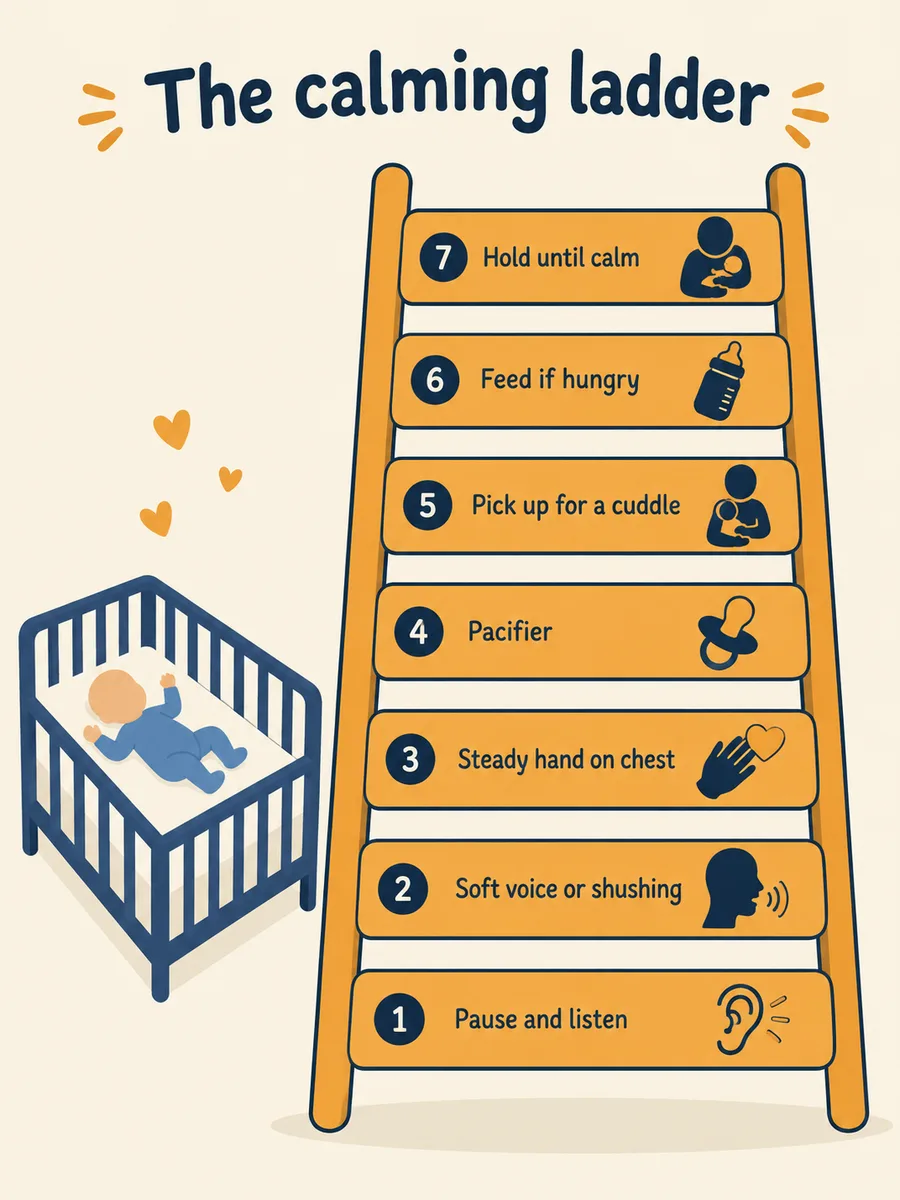
Two small habits help here. First, pause for noises and respond to cries: newborns are noisy in light sleep, and a minute or two of waiting helps you tell sleepy sounds from true crying. Second, if baby falls asleep in your arms and you have to hold the whole nap, nothing is wrong. If baby only settles in your arms, see newborn won't sleep unless held.
Newborns are not ready for sleep training, and this approach never leaves a newborn to cry alone. Many babies under 3 months need help to fall asleep, and holding, rocking and feeding to sleep are not mistakes.
Stage 5: Build a gentle rhythm for days and nights
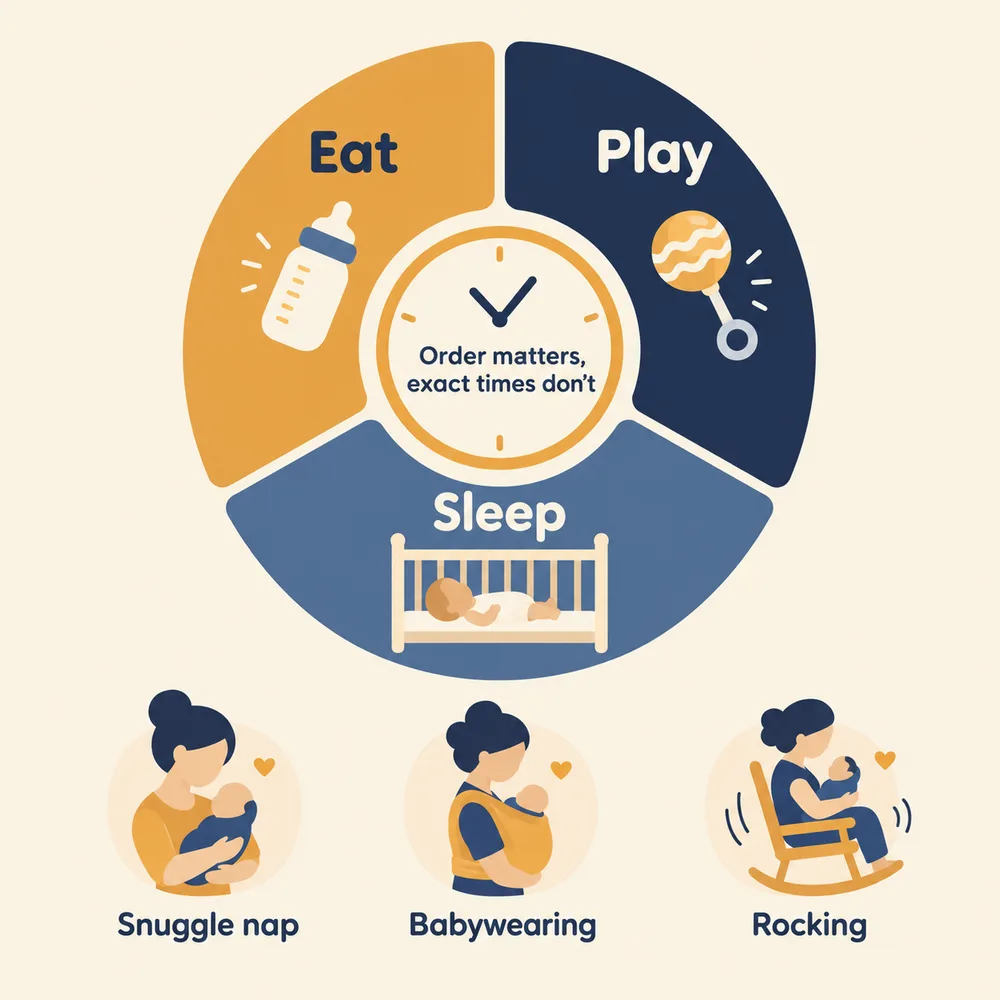
A rhythm is a loose order of events that repeats through the day. It is not a schedule. The simplest version is eat, play, sleep: feed when baby wakes, add a little awake time, wind down at the first sleepy cues, and repeat. In the first weeks, "play" might be thirty seconds of looking at your face, and that counts.
Then give days and nights different jobs:
| During the day | During the night |
|---|---|
| Open the curtains, natural light | Dim lights, nightlight if needed |
| Chat, sing, play | Quiet voice, minimal talking |
| Full, sociable feeds | Calm, efficient feeds in low light |
| Normal household noise is fine | White noise at a safe volume, across the room |
For night wakings, use the same short order each time: pause, feed if hungry in a dim room, burp, change the diaper only if needed, lay baby down on their back and go back to sleep yourself. An optional dream feed shortly before you go to bed helps some families and does nothing for others, so drop it if it wakes baby.
What does a realistic hope look like? In the first weeks, expect to feed every 2 to 3 hours around the clock, or as your pediatrician advises. Some babies begin to string together longer stretches at night between 6 and 12 weeks, and others take longer. We can work toward longer stretches, but we cannot promise them. Be wary of anyone who promises a specific number of hours.
For a short bedtime order you can repeat, see the newborn bedtime routine.
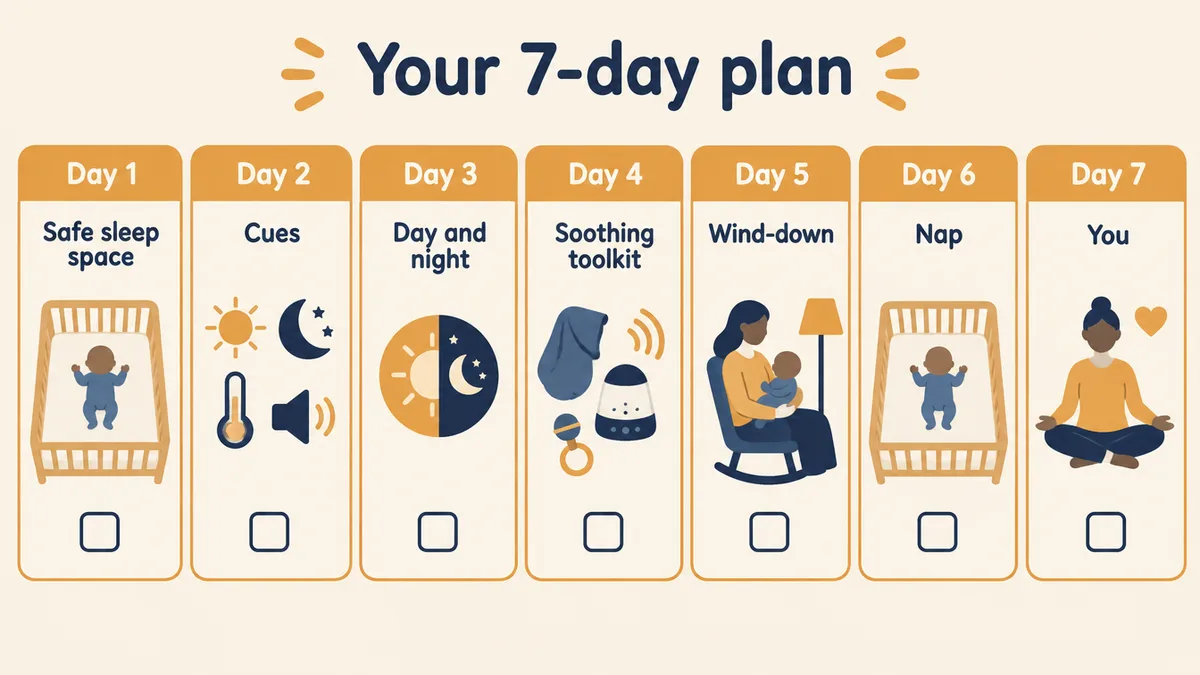
A 7-day way to start
You do not need to do all of this tonight. Pick one small step a day, and if you miss a day, pick up where you left off.
- Day 1, safe sleep: do the sweep of the sleep space and share it with anyone who cares for baby.
- Day 2, cues: watch baby's face for sleepy cues at three wake-ups and jot notes.
- Day 3, day and night: open curtains by day, dim lights and quiet voices at night.
- Day 4, soothing: try two tools and note which one works.
- Day 5, wind-down: create a 5-minute pre-sleep routine: feed, change, song, down.
- Day 6, nap: try one nap in the sleep space and keep the rest flexible.
- Day 7, you: plan a rest block and accept one offer of help.
Protect your own rest
A calm parent helps a baby more than a perfect routine. Take turns with a partner or helper so one of you gets a longer stretch, and use contact naps when you need them as long as you stay awake and alert. If you feel drowsy, move baby to their own firm, flat sleep space on the back, and do not nap with baby on a sofa or armchair.
When to call the pediatrician
Sleep problems are rarely an emergency, but some signs are. Call your pediatrician if baby is hard to wake or very floppy, is refusing multiple feeds, has fewer wet diapers than expected, has persistent vomiting, or is under 3 months with a rectal temperature of 100.4°F (38°C) or higher. If baby is struggling to breathe, has blue or gray skin or lips, or you cannot wake them, call emergency services right away. Crying that is high-pitched, constant and cannot be soothed for hours also deserves a call. Trust your instincts: when in doubt, call.
Where the Playbook fits
The Newborn Sleep Playbook is the plan version of this page. It has 13 chapters in 46 pages, including safe sleep first, wake windows by week, sleepy cues vs. overtired cues, the soothing toolkit, a flexible daily rhythm, naps, nights and a 7-day starter plan, plus a web app with a wake-window timer and soothing sounds. It is educational and does not replace your pediatrician's advice.