Safe Sleep for Newborns: A Nursery Setup Checklist
The core of newborn safe sleep fits in a short list: back to sleep, on a firm and flat surface, in an empty crib or bassinet, in your room but not your bed, for every nap and every night. These steps come from the American Academy of Pediatrics (AAP) 2022 policy statement on sleep-related infant deaths and the NIH Safe to Sleep campaign, and they apply from day one. They are linked with a lower risk of sleep-related infant deaths, including SIDS. No setup guarantees prevention, which is why each step matters. This page turns the guidance into a checklist you can walk through tonight.
The ABCs of safe sleep
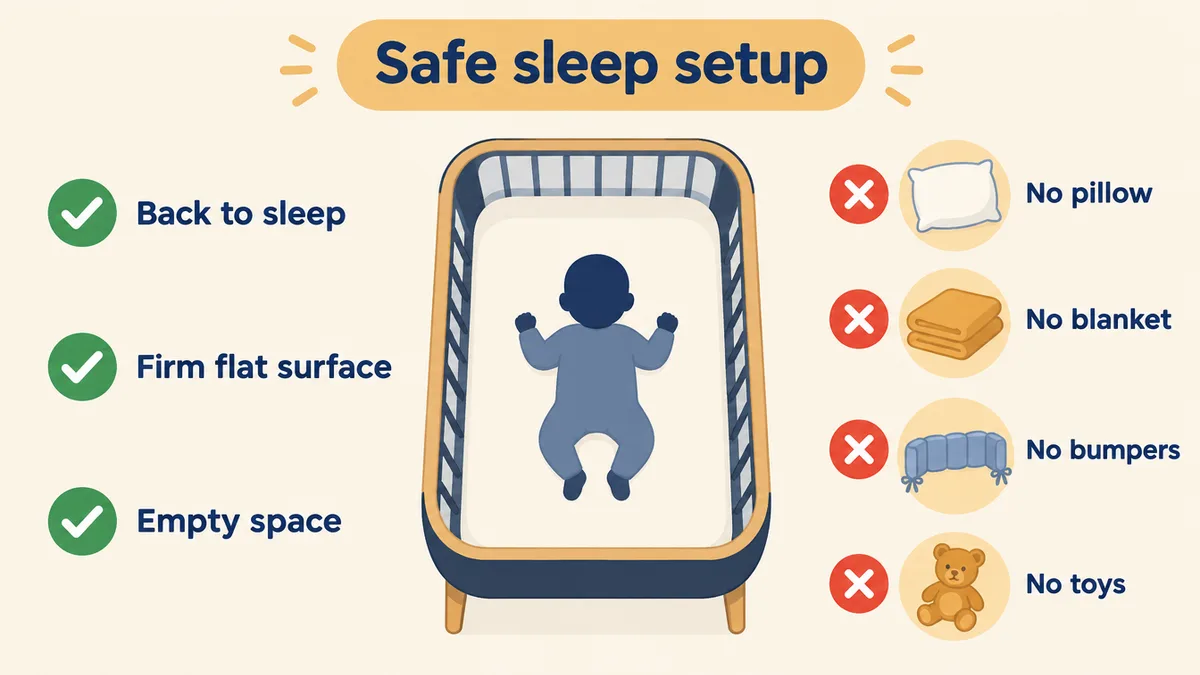
Alone. Back. Crib. Baby sleeps alone on their back in a crib, bassinet or play yard that meets current safety standards, every time.
The essentials
- Always on the back. For every sleep, until age 1. Once baby can roll both ways on their own, you do not need to flip them back, but always start the sleep on the back.
- Firm, flat surface. A crib mattress, bassinet or play yard in a product that meets safety standards (CPSC), covered by a fitted sheet made for it.
- Empty sleep space. No pillows, blankets, comforters, bumper pads, wedges, positioners or soft toys.
- Room-share, do not bed-share. The AAP recommends sleeping in the same room as your baby, close to your bed but on a separate surface, ideally for at least the first 6 months.
- No inclined sleepers. Products with an incline of more than 10 degrees are not safe for sleep. That includes many rockers, nests and loungers. If baby falls asleep in one, move them to a flat surface.
- Avoid sleep in car seats, strollers and swings when not traveling. Move baby to a flat surface when you can.
- Offer a pacifier at nap and bedtime once feeding is going well. Do not hang it around baby's neck or attach it to clothing.
- No smoking, vaping or alcohol around baby.
- Dress for the room. No more than one more layer than an adult would be comfortable in. Do not cover the head.
- Do not rely on monitors that claim to reduce SIDS risk. Follow the other recommendations instead.
- Keep up with regular pediatric care and vaccines.
The sleep surface
The surface does most of the safety work. Firm and flat are the two words to remember.
| Surface | Use for sleep? | Notes |
|---|---|---|
| Crib mattress, firm and flat | Yes | Fitted sheet only |
| Bassinet or play yard, as sold | Yes | Use the mattress or pad that came with it. Do not add padding |
| Adult bed, sofa, armchair | No | Higher risk for infant sleep, with or without a parent |
| Inclined sleepers, nests, loungers | No | Not for sleep |
| Car seat, swing, bouncer | Not for routine sleep | Move baby to a flat surface when you can |
A firm mattress does not dent when baby lies on it. It should fit the crib with no gaps: if you can fit more than two fingers between the mattress and the crib side, it is too loose. Use only a fitted sheet made for that mattress.
What stays out of the crib
If you picture a crib in a catalog, take most of it out. The safest crib looks almost bare.
| Leave out | Why |
|---|---|
| Pillows and cushions | Soft items can block baby's nose and mouth |
| Loose blankets and quilts | Can cover baby's face or cause overheating. Use a sleep sack instead |
| Bumper pads (including mesh) | Not recommended. They add suffocation risk without proven injury protection |
| Stuffed toys | Soft and can cover the face |
| Positioners and wedges | Not needed and not recommended for sleep |
| Mobiles with long parts | Keep any mobile out of reach, and remove it once baby can push up |
Rule of thumb: baby, a fitted sheet and, if needed, a snug sleep outfit or wearable blanket. A lovey can wait until after 12 months.
Temperature and clothing
Overheating is a known concern. The goal is a room that is comfortable for a lightly dressed adult, and baby dressed in one more light layer than you would wear. Many sources commonly cite a room between about 68 and 72°F (20 to 22°C) as a starting point, not a rule. A wearable blanket (sleep sack) keeps baby warm without loose blankets. Feel baby's chest or the back of the neck: warm is right, hot or sweaty means remove a layer. Cold hands and feet alone are normal. Do not put a hat on baby for sleep indoors.
Swaddling, safely
If you swaddle, always place baby on the back, keep the hips loose, and keep the wrap snug at the chest but not tight. Stop swaddling at the first signs your baby is trying to roll, often around 2 months, sometimes earlier. A swaddle should never cover the face. See how to swaddle a newborn safely.
White noise and night lights
Keep the sound machine across the room, never on or in the crib, at conversation volume or lower. See white noise for newborns. For a night light, choose a dim, warm-colored light, placed low and across the room.
If you might fall asleep with baby
Feeding or comforting a baby at 3 a.m. is when many parents doze off. Plan ahead: it is safer to feed baby in an adult bed than on a sofa or armchair, with no pillows or blankets near baby. Have a plan to move baby to their own sleep space as soon as you wake.
Car seats, strollers and carriers
These are great for getting around, but not for sleep once you arrive. Babies who sleep sitting up or inclined can slump so that their chin presses on the chest, narrowing the airway. If baby falls asleep in a seat, carrier or swing, move them to a firm, flat sleep surface as soon as it is safe.
Monitors and gadgets
The AAP does not recommend home cardiorespiratory monitors or wearable devices as a way to reduce the risk of SIDS. A video monitor can be a handy way to check on baby, but it is a convenience and not a safety system. Keep monitor cords out of reach.
Printable checklist
- Baby is on their back.
- Surface is firm and flat.
- Fitted sheet only, nothing else in the crib.
- Baby is in my room, on their own surface.
- No inclined sleepers, nests or positioners.
- Swaddle is hip-healthy, and baby is not trying to roll.
- Baby is not overdressed and the room is comfortable.
- No smoking or vaping near baby.
- Pacifier offered (if feeding is going well), clean and not on a cord.
- Caregivers (grandparents, sitters) know these rules too.
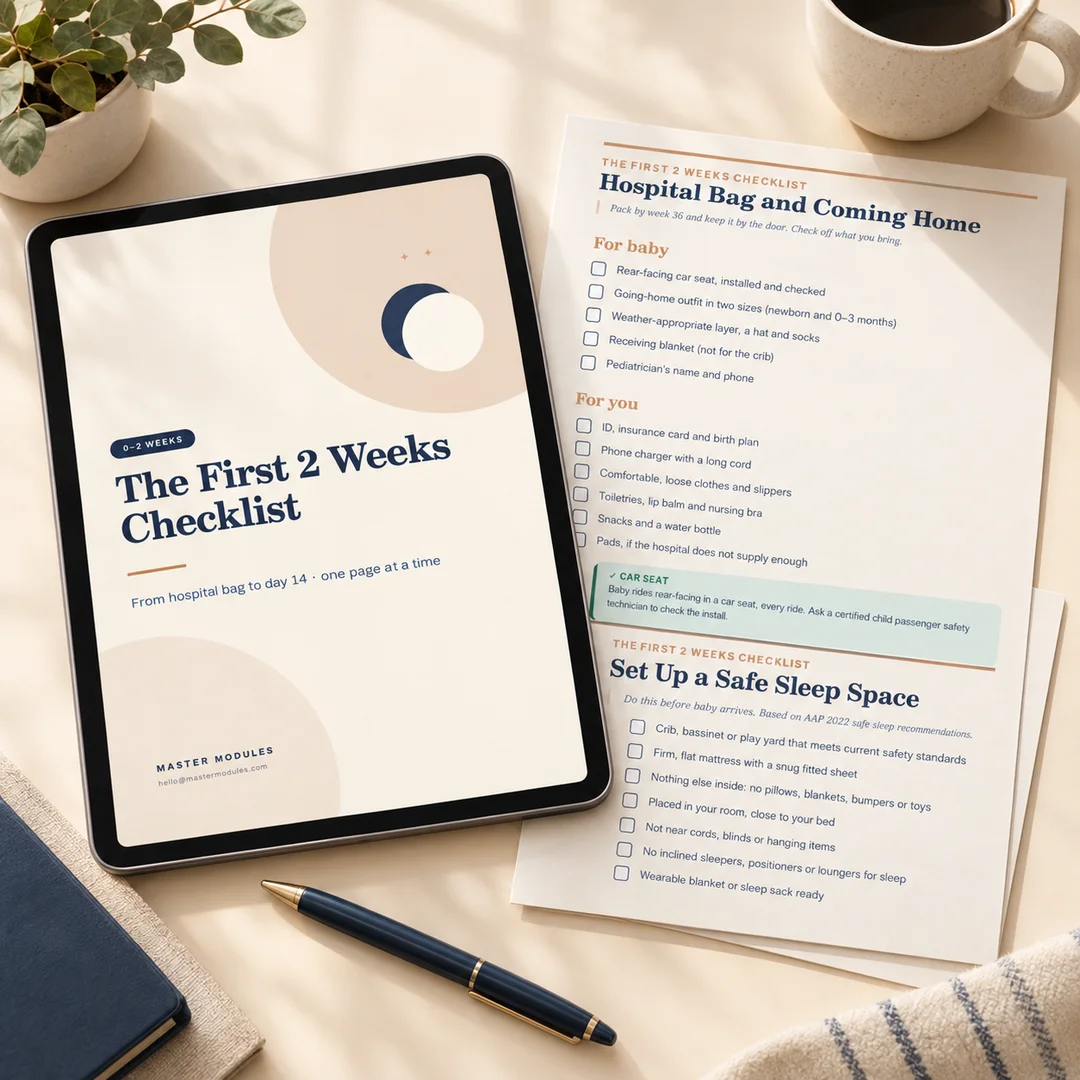
Do a 60-second sweep of the sleep space tonight, then show the same checklist to anyone who puts baby to sleep.
When to call
Call your pediatrician if your baby has a medical condition and someone suggests a different sleep position or surface. Call 911 if baby is limp, blue, not breathing or hard to wake. This page is a summary of public guidance. Read the AAP and Safe to Sleep sources, and ask your pediatrician about your baby.
More from the product
The Newborn Sleep Playbook includes a Safe sleep first chapter, a bonus Safe Sleep Nursery Setup Guide with a printable checklist, and a Safe sleep check in the web app. For everything to do in the first two weeks, see the newborn checklist for the first two weeks.